

AI has traditionally been something you ask questions.
You give it a prompt, it gives you an answer, and you decide what to do next.
That is changing.
New AI systems can take a goal, decide what needs to happen, use different tools, and keep working until the task is finished or it reaches a point where a human needs to step in.
That is where AI agents come in.
But what actually makes something an AI agent? And how different are they from automation tools such as Robotic Process Automation (RPA)?
The difference becomes clearer when you look at how they work.
What Is an AI Agent?
An AI agent is a software system that can take a goal, decide which steps are needed, use available tools, and take actions to achieve that goal.
The important part is how it decides what to do next.
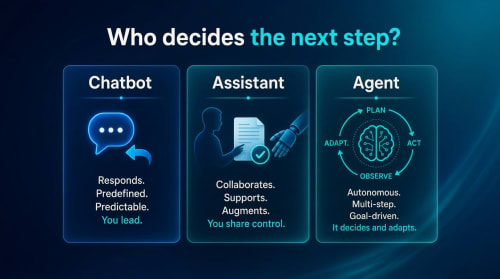
A normal AI model usually produces an output from an input. You ask a question, and it generates a response.
An AI assistant can go further. It may help you write something, search for information, or suggest what to do. But you are still driving the process.
An AI agent is given a goal and can decide the steps needed to reach it.
For example, instead of telling an AI:
"Check these customer complaints and summarize them."
you could give an agent a broader goal:
"Review new customer complaints, identify issues that can be resolved automatically, update the relevant records, and send difficult cases to the support team."
The agent has to work out what needs to happen between the request and the final result.
That ability to choose and carry out its own steps is what separates an agent from a simple AI interface.
How Do AI Agents Work?
Most AI agents follow a loop that looks something like this:
Goal → Understand → Plan → Use tools → Take action → Check result → Continue or stop
The exact implementation varies, but the basic idea is similar.
An agent usually has five important parts:
- Model: Provides the reasoning and language capabilities needed to understand the task and make decisions.
- Tools: Give the agent access to things such as databases, APIs, websites, files, or business software.
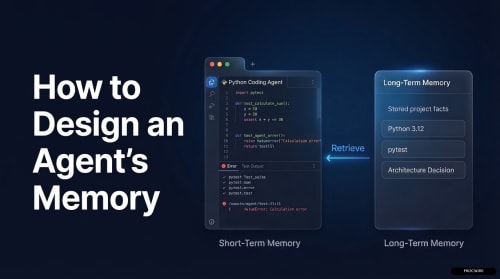
- Memory and context: Provide information about the current task and, where appropriate, previous interactions or results.
- Planning: Helps the agent break a larger goal into smaller steps and decide what to do next.
- Guardrails: Limit what the agent can access or change and determine when human approval is required.
Imagine an operations team asks an agent to investigate a failed customer payment.
The agent could first check the payment record, look at the customer's account, identify the reason for the failure, and then decide what action makes sense.
If the payment failed because of an expired card, it might send the customer an appropriate message and update the case.
If the situation is unusual, it could stop and send the case to a human.
The important thing is that the agent is not simply following a fixed sequence such as "click this, then click that." It is interpreting the situation and choosing what to do based on the goal and the information available to it.
What Can AI Agents Actually Do?
AI agents are already being used for tasks that require more than generating text.
Software development
A coding agent can inspect an existing codebase, understand how different files relate to each other, make changes, run tests, examine failures, and make further changes.
Instead of simply suggesting code, it can work through the development task itself.
Customer operations
Customer support is another useful example because it shows the difference between a chatbot and an agent.
A basic chatbot may answer a customer's question using information from a knowledge base.
An agent can interpret the customer's request, retrieve information from business systems, check the customer's account, perform an allowed action, and escalate the case when it cannot safely resolve it.
Financial research
AI agents can also be used for financial research, where they may need to work with large amounts of information from different sources.
A recent example is OpenAI's ChatGPT for Financial Services, launched on September 10, 2026.
The product is designed for areas such as investment banking and equity research. It combines GPT-6 Astra with financial data from providers including Daloopa, PitchBook, and LSEG News to help teams with research, financial modelling, and client materials.
It also includes enterprise controls such as role-based access, encryption, and workspace audit capabilities, which is important when AI is working with sensitive financial information. Morgan Stanley and Evercore
These examples show that agents are moving beyond answering questions. They are increasingly being designed to carry out parts of real workflows.
AI Agents vs. RPA: What's the Difference?
The simplest way to think about it is:
RPA follows instructions. AI agents pursue goals.
Robotic Process Automation (RPA) is built around predefined workflows. If you know exactly what should happen every time, that can be a major advantage.
An agent is more useful when the path can change depending on what it finds.
| AI Agents | RPA | |
|---|---|---|
| Approach | Goal-oriented | Rule and workflow-oriented |
| Decision-making | Can interpret situations and choose next steps | Follows predefined rules |
| Input | Can handle unstructured or changing information | Works best with predictable inputs |
| Adaptability | Can adjust its approach | Usually needs workflow changes |
| Execution | Can choose which tools or actions to use | Executes configured actions |
| Best for | Complex, variable, multi-step tasks | Stable, repetitive, high-volume tasks |
| Reliability | Can vary depending on reasoning and context | Highly predictable when the workflow is stable |
Consider invoice processing.
An RPA bot can be excellent at taking information from a known system, entering it into another system, and following the same steps thousands of times.
But what happens when an invoice does not match the expected format?
An agent could interpret the invoice, look for relevant information, investigate the discrepancy, and decide whether it can resolve the issue or needs human review.
That does not mean the agent makes RPA obsolete.
In many cases, they can work together.
The agent judges what should happen. RPA executes the predictable downstream work.
When Should You Use an AI Agent?
An AI agent makes more sense when a task involves things like:
- Interpreting information rather than simply moving it.
- Handling inputs that can change from one case to another.
- Choosing between multiple possible paths.
- Working with several tools or systems.
- Dealing with frequent exceptions.
- Making decisions based on context.
For stable, repetitive, high-volume work, RPA can still be the better choice.
If a process has clear rules and rarely changes, there may be little reason to introduce an AI system that has to reason about something a simple workflow can already handle reliably.
The goal should not be to use an agent because the technology exists.
The goal should be to use one when the problem actually requires it.
The Challenges of AI Agents
The flexibility of agents also creates new problems.
An agent can make an incorrect decision. It can misunderstand information. It can take an unexpected action. And the more systems it can access, the greater the consequences of a mistake can become.
There are also practical challenges around:
- Security and permissions
- Access to business data
- Usage and model costs
- Integration with existing systems
- Human oversight
- Monitoring and troubleshooting
- Reliability of decisions
Integration is one of the biggest practical issues.
An agent may be capable of reasoning about a task, but that does not automatically give it access to the systems required to complete the task. Connecting an agent safely to databases, internal software, APIs, and business processes can take significant work.
Enterprise platforms are also putting more attention on control.
For example, Salesforce's Agentforce security model uses permissions, access controls, audit trails, least-privilege principles, and agent-specific guardrails. Salesforce also supports human-in-the-loop controls for certain actions.
That is an important point.
The challenge is not simply making agents more autonomous. It is making sure that their autonomy stays within boundaries the business can understand and control.
What Could the Future of AI Agents Look Like?
AI agents will likely become more connected to the software people already use.
Instead of working inside one application, an agent may be able to move between a CRM, email, databases, project management software, and other business systems to complete a task.
We are also likely to see more specialized agents built for specific industries and types of work.
For higher-risk tasks, human approval will remain important. Monitoring, permissions, audit trails, and clear limits will become normal parts of deploying agents rather than optional extras.
There may also be systems where multiple specialized agents work together, with each handling a different part of a larger task.
That does not mean agents will replace every employee.
The more realistic direction is that they will change which parts of a job people spend their time on.
Conclusion
AI agents move automation from fixed instructions toward goal-based execution.
That makes them useful for tasks where information changes, decisions are required, and there is no single path from start to finish.
But flexibility comes with a cost. Agents need access to the right systems, clear permissions, monitoring, and human oversight when the consequences of a mistake are high.
RPA is not going away either. For predictable processes, it can still be the simpler and more reliable option.
The interesting question is not whether AI agents are better than RPA.
Where could an AI agent solve a problem in your workflow that a fixed RPA process simply cannot?


Comments